
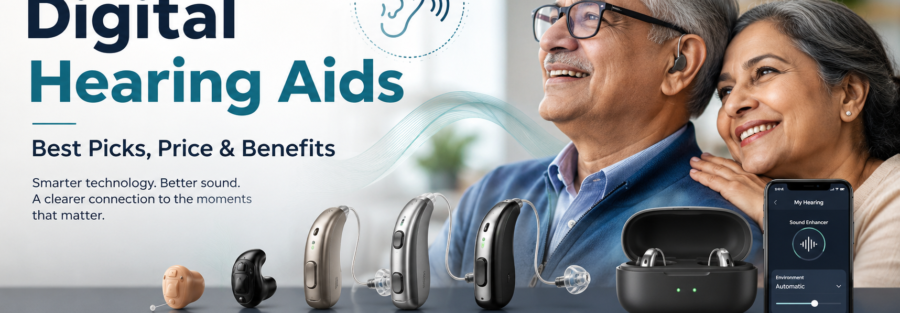
If your ears aren’t catching what they used to, you’re not alone — and the good news is that today’s technology solves the problem far better than anything from a decade ago. Modern digital hearing aids don’t just make sound louder. They read your surroundings, cut background noise, and stream calls straight from your phone. This guide walks you through the best picks in India, real price ranges, the honest differences between digital and analog devices, the benefits worth paying for, and how to choose a device that actually fits your life. Let’s get into it.
What Digital Hearing Aids Actually Are
Here’s the simple version. These devices capture sound through tiny microphones, convert it into a digital code using a computer chip, and then reshape that sound to match your exact hearing loss before sending it into your ear. Analog aids, by contrast, just amplify the whole sound wave — everything gets louder, including the noise you don’t want.
That single difference changes everything. A digital chip can tell the difference between your grandchild’s voice and the clatter of a restaurant. It boosts one and softens the other. Most hearing aids sold today are built this way, and for good reason. According to Mayo Clinic, nearly all current models use a computer chip to process sound and adjust it based on your hearing loss, what you need to hear, and how loud your environment is.
So when people ask about these devices, they’re usually asking about the standard of care in 2026 — not some premium upgrade. Analog is the old way. Digital is simply how modern devices work. The chip is the brain of the device, and everything else — microphones, receiver, battery — supports it.
Think of it like the jump from film cameras to smartphones. The old approach worked, but the new one adapts, corrects, and improves the picture in real time. That’s exactly what a modern hearing device does with sound.
Digital vs Analog Hearing Aids: The Real Difference
Let’s be honest — the digital vs analog hearing aids debate is mostly settled. Analog devices have almost disappeared from the Indian market. But understanding why helps you appreciate what you’re paying for, and it explains why the modern approach costs what it does.
Analog hearing aids amplify all sound signals the same way. Turn up the volume and you turn up everything: speech, traffic, the fan overhead, the rustle of a newspaper. For someone in a quiet room, that can work fine. Step into a crowded market and it becomes exhausting. There’s no intelligence in the amplification — just raw volume.
Modern devices work differently. The chip breaks sound into channels, analyses each one, and makes thousands of tiny adjustments every second. It can suppress a sudden bang, sharpen a soft consonant, and adapt as you move from a quiet home to a noisy street. This is why the digital vs analog hearing aids comparison almost always lands in favour of the newer technology. It’s not a small edge — it’s a fundamentally better way of hearing.
There’s also the matter of personalisation. An analog device offers a volume dial and little else. A digital one is programmed to your specific audiogram, so the sounds you struggle with most get the most help. Two people with the same device can have completely different settings, each tuned to their own ears.
| Feature | Digital Devices | Analog Devices |
| Sound processing | Converts sound to code, adjusts per channel | Amplifies the whole signal uniformly |
| Noise reduction | Yes — separates speech from background | Minimal — everything gets louder |
| Customisation | Precisely programmed to your hearing test | Basic volume control only |
| Bluetooth streaming | Available on most models | Not available |
| Rechargeable option | Widely available | Rare |
| Price in India | ₹15,000 to ₹3,00,000+ | Largely discontinued |
The takeaway? If you’re buying today, you’re buying digital. The question isn’t digital or analog — it’s which device suits you best.
Best Digital Hearing Aids in India (2026 Picks)
Picking the best digital hearing aids depends on your hearing profile, your budget, and how much you care about discretion versus power. That said, a handful of models keep coming up as strong choices this year. Here are the standouts, along with what makes each one worth a look.
Signia Pure Charge&Go IX — A sleek, rechargeable device with strong app control and a natural sound signature. It’s become one of the more popular premium picks in India, starting near ₹77,990. Signia has a reputation for discreet designs and smartphone integration, which appeals to younger users and anyone who dislikes the look of traditional aids.
Widex Moment — Widex earns its reputation for the most natural sound quality and strong tinnitus relief, with starting prices around ₹20,000 for entry models. If ringing in the ears is part of your problem, Widex is often the brand audiologists reach for first.
Phonak Audeo Lumity / Infinio Sphere — Phonak’s flagship receiver-in-canal line is a favourite among working professionals for its SmartSpeech technology and excellent speech-in-noise performance. It’s not cheap, but it delivers. Prices for the Audeo Lumity R sit around ₹1,05,000 per ear, while the newer Infinio Sphere climbs higher, into the ₹2,00,000-plus range. If your daily life involves meetings, phone calls, and noisy environments, this is a serious contender.
Oticon Intent — Built on Oticon’s BrainHearing approach, this one focuses on natural, effortless listening. The idea is to give your brain the full soundscape rather than an over-processed version of it. It’s frequently listed among the most highly regarded receiver-in-canal devices in India for 2026.
ReSound Nexia MicroRIE — iPhone-ready, smart, and comparatively accessible, with entry pricing from around ₹40,990. Good for tech-savvy users who want strong smartphone integration and smart environment adaptation without the flagship price tag. ReSound has long been known for iPhone compatibility, and this model continues that tradition.
Oticon and GN ReSound entry lines — For tighter budgets, entry models from major brands start between ₹19,990 and ₹30,000, offering solid digital processing at an accessible price. These won’t match the flagships in noisy settings, but for mild loss in quieter lives, they’re plenty.
Honestly, most buyers get overwhelmed by brand names. Don’t. The best devices for you are the ones an audiologist fits and programs to your specific hearing test. A mid-range device fitted correctly beats a flagship device fitted poorly, every single time. Brand matters less than the fit and the follow-up care behind it.
Digital Hearing Aids Price in India: What You’ll Actually Pay
Now for the question everyone wants answered — the price. Prices in India swing widely, and that’s because “hearing aid” covers everything from a basic amplifier to an AI-powered premium device. There’s no single number, but there are clear tiers.
Here’s the honest range. Basic models start from around ₹12,000 to ₹15,000. Mid-range devices with better noise reduction and Bluetooth land between ₹40,000 and ₹1,00,000. Premium and AI-driven flagship models can reach ₹3,00,000 and, for the very top tier, beyond. That’s per ear, which matters — if you need two, budget accordingly.
Rechargeable models — which most people now prefer — typically start around ₹45,000 and go up to ₹4,50,000 depending on features like Bluetooth, noise cancellation, and AI processing. The convenience of never fumbling with tiny batteries is worth a lot to many users, especially seniors.
| Tier | Price (per ear) | What You Get |
| Entry-level | ₹12,000 – ₹25,000 | Basic amplification, volume control, mild loss |
| Mid-range | ₹40,000 – ₹1,00,000 | Noise reduction, Bluetooth, rechargeable |
| Premium | ₹1,00,000 – ₹3,00,000 | AI processing, best speech-in-noise, streaming |
| Flagship | ₹3,00,000+ | Top-tier chips, invisible fits, full ecosystem |
A quick note on pricing traps. Online prices often look lower than clinic prices — but clinic-fitted devices include professional programming, real-ear measurements, warranty support, and follow-up care. That aftercare is what makes a hearing aid actually work for you, so the price you pay at a good clinic usually delivers better long-term value than a cheaper online box. Many clinics also offer EMI options, which spreads a premium purchase into manageable monthly payments.
Why does this matter so much? Because a device is only as good as its programming. Buy the cheapest box online, skip the fitting, and you’ve often wasted your money. The digital hearing aids price is really the price of the device plus the expertise that makes it work.
Understanding Digital Hearing Aids Cost: Why the Range Is So Wide
Why does the digital hearing aids cost vary from ₹15,000 to over ₹3,00,000? A few things drive it, and knowing them helps you spend wisely.
Technology tier. The chip inside is the biggest cost factor. Higher tiers process more sound channels, adapt faster, and handle noisy environments better. You’re paying for silicon and software, not plastic. A premium chip might process dozens of channels; a basic one, just a handful.
Style and size. Smaller custom styles like completely-in-canal and invisible-in-canal need precision manufacturing and miniaturised parts, which pushes production costs up. Behind-the-ear models tend to be more economical because engineers have more room to work with components and batteries.
Features. Bluetooth connectivity, rechargeability, tinnitus masking, automatic environment switching, and AI-based processing all add to the cost — but they genuinely improve daily comfort and clarity. Each feature you add nudges the price higher, so it pays to know which ones you’ll actually use.
Severity of loss. Mild to moderate losses can be managed with lower or mid-tier power, keeping prices moderate. Severe to profound losses need powerful receivers, stronger processors, and robust feedback control, which raises the cost of the device.
Brand investment. Established international brands charge more because they pour money into research, chip design, and software ecosystems. Sometimes you’re paying for a genuinely better product; sometimes you’re paying for the name. An audiologist helps you tell the difference — that’s part of what you get from a proper clinic.
Worth noting: the cost is rarely a one-time number. Factor in batteries or charging, follow-up visits, cleaning supplies, and the warranty period when you budget. A device that lasts about five years — the typical lifespan Mayo Clinic cites — spreads that expense out nicely. Divide the total by five years of daily use and even a premium device starts to look reasonable.
Key Benefits of Digital Hearing Aids
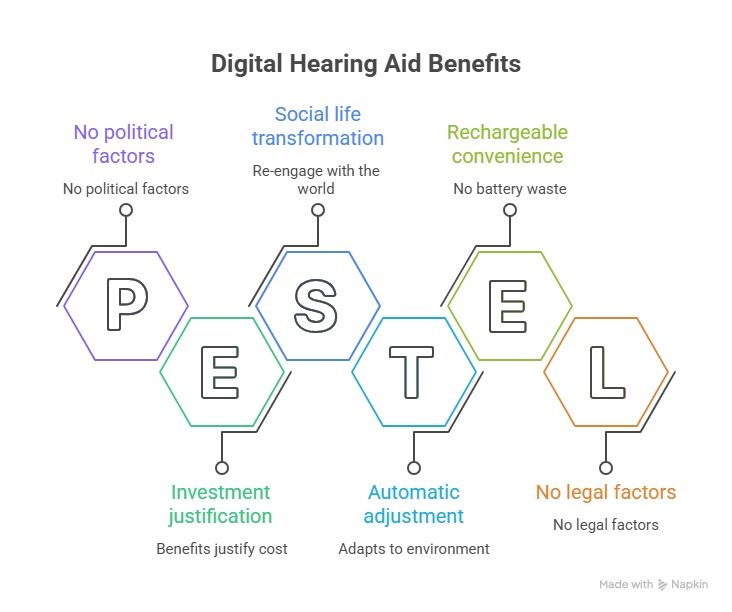
Why go digital? Beyond the obvious clarity boost, here’s what these devices actually do for daily life — and why the benefits justify the investment for most people.
Sharper speech in noise. This is the headline benefit. Digital processing separates the voice you want to hear from the din around it — restaurants, family gatherings, busy streets become manageable again. For many users, this alone transforms their social life.
Automatic adjustment. You move from a quiet room to a noisy one and the device adapts on its own. No fiddling with dials. The chip senses the environment and switches settings for you.
Bluetooth streaming. Many models connect to smartphones, TVs, and music players. Calls come straight into your ears, and you can watch television at your own volume without disturbing anyone. For a lot of users, this convenience alone justifies the upgrade.
Rechargeable convenience. No more tiny batteries to swap. A three-hour overnight charge on most rechargeable receiver-in-canal models gives 20 to 24 hours of use, including several hours of streaming. Drop them in the case at night, pick them up ready in the morning.
Discreet designs. Modern receiver-in-canal and completely-in-canal devices are small and hard for others to spot. The days of bulky, obvious aids are gone. Many people worry about looking older or dependent — today’s designs quietly put that worry to rest.
Tinnitus relief. Several premium models include tinnitus-masking features that help with ringing in the ears — something analog devices simply couldn’t do. For people whose hearing loss comes bundled with tinnitus, this is a genuine quality-of-life upgrade.
Better mental engagement. Untreated hearing loss is linked to social withdrawal and cognitive strain. When conversations become easy again, people re-engage — with family, with work, with the world. That’s the quiet, underrated benefit that rarely makes it onto a spec sheet.
Which brings us to a point people underestimate: comfort and consistency. A device you actually enjoy wearing is a device you’ll wear all day, and that’s what improves your hearing over time. The best technology in the world does nothing sitting in a drawer.
How to Choose the Right Digital Hearing Aid
So how do you actually pick? Here’s a practical, step-by-step path that keeps you from overspending or under-buying.
Start with a hearing test. Before anything else, get your hearing checked by a qualified audiologist. Your audiogram determines everything — the power you need, the style that fits, the features that matter. Guessing is how people end up with the wrong device.
Rule out treatable causes. Sometimes hearing loss comes from earwax buildup or an infection. A quick health check can save you from buying a device you don’t actually need. Mayo Clinic recommends this step before any purchase.
Match the style to your loss and lifestyle. Receiver-in-canal suits mild to severe loss and is the most popular style in India for good reason. Behind-the-ear handles severe to profound loss and durability. Completely-in-canal and invisible styles prioritise discretion. Discuss the trade-offs openly with your audiologist.
Ask about a trial period. Most clinics offer a trial — often three days or more. Use it. Wear the device in your real life: at home, at work, in a noisy market. Get the trial terms in writing, including what happens if you return it.
Check the warranty. Make sure it covers parts and labour for a solid period. Ask whether office visits and follow-up programming are included, and whether you can extend the warranty later.
Think about future needs. Ask if the device’s power can be raised later if your hearing declines. A device that grows with you is smarter value than one you’ll outgrow in two years.
Beware of claims that sound too good. No hearing aid restores perfect hearing or erases all background noise. Mayo Clinic warns against sellers who promise more than a device can deliver. These devices improve hearing — they don’t cure it, and honest providers say so upfront.
Digital Hearing Aid Styles Explained
Devices come in several styles, and the right one balances your hearing loss against how visible you want the device to be. Here’s how they stack up.
Receiver-in-Canal (RIC) — The most widely fitted style in India. A small casing sits behind the ear with the speaker in the canal, connected by a thin, nearly invisible wire. Discreet, comfortable, and Bluetooth-ready. Ideal for mild to severe loss, and comfortable even in India’s hot, humid climate.
Behind-the-Ear (BTE) — Hooks over the ear and delivers the most power. Best for severe to profound loss and known for durability. Newer models are smaller than the bulky versions of the past, and many now include rechargeable batteries.
In-the-Ear (ITE) — Fills part or all of the outer ear bowl. Easier to handle than tiny styles, with room for features like volume control and a larger battery for longer life. A good middle ground for those who find smaller devices fiddly.
Completely-in-Canal (CIC) / Invisible (IIC) — The smallest and hardest to see. Great for cosmetic discretion, though they use tiny batteries with shorter life, offer limited controls, and often skip Bluetooth. Best for mild to moderate loss where invisibility is the top priority.
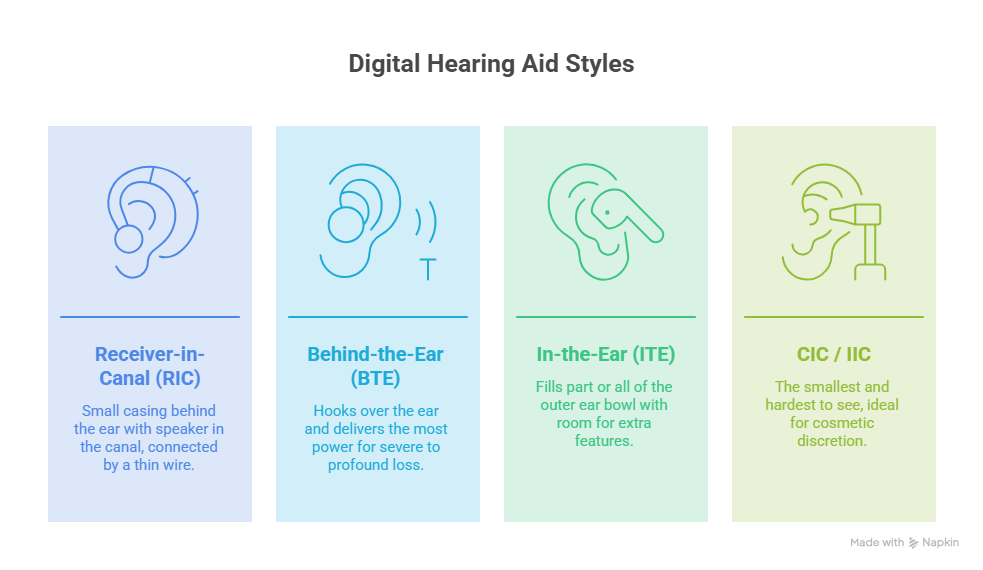
Each style trades something. Smaller means more discreet but usually fewer features and shorter battery life. Bigger means more power and more control. Your audiologist helps you find the sweet spot between how you want the device to look and how well you need it to perform.
Caring for Your Digital Hearing Aids
A good device deserves good care, and proper care extends its life well past that five-year mark. It also protects your investment.
Keep them dry — moisture and earwax are the two biggest enemies, especially in India’s humid climate. Wipe them daily with a soft, dry cloth. Store them in a drying case or with a dehumidifier overnight. Clean the receiver regularly to stop earwax clogging the speaker, which is one of the most common causes of a device that suddenly sounds muffled.
Go back for follow-up visits, too. Audiologists can fine-tune the programming and catch small problems before they become big ones. Many clinics include a few follow-up visits in the purchase price, so use them.
Give yourself time to adjust. When you first wear a new hearing device, everything sounds different — even your own voice. That’s completely normal. The more you wear it, the faster your brain adapts to amplified sound. Most people find their listening comfort improves steadily over the first few weeks. Practise in different settings — quiet rooms, busy streets, restaurants — so you learn how the device behaves everywhere you go.
Final Thoughts
Digital hearing technology has quietly transformed what it means to live with hearing loss. They’re smarter, smaller, and more capable than ever — and with prices spanning ₹12,000 to over ₹3,00,000, there’s a device for nearly every budget and every degree of loss. The best choice isn’t automatically the most expensive one; it’s the device fitted and programmed to your hearing by a qualified professional. So book a hearing test, try before you buy, check the warranty, and choose something that fits your life. Better hearing is closer — and more affordable — than most people think.
Also read: Hearing Aid Price in India 2026 · Best Non Visible Hearing Aids in India 2026 · Our Hearing Care Services
Frequently Asked Questions
Are digital devices better than analog?
Yes, in almost every case. Digital devices process sound intelligently, reduce background noise, and can be precisely programmed to your hearing test. Analog aids simply amplify everything uniformly. This is why analog models have largely disappeared from the Indian market.
What is the digital hearing aids price in India?
The digital hearing aids price in India ranges from around ₹12,000 to ₹15,000 for basic models up to ₹3,00,000 and beyond for premium AI-powered devices. Mid-range Bluetooth and rechargeable models typically fall between ₹40,000 and ₹1,00,000 per ear.
How much does a rechargeable device cost?
Rechargeable models in India usually start around ₹45,000 and go up to ₹4,50,000, depending on features like Bluetooth, noise cancellation, and AI processing. Most give a full day’s use from a single overnight charge.
Which are the best digital hearing aids in India in 2026?
Phonak Audeo Lumity, Oticon Intent, Signia Pure Charge&Go IX, ReSound Nexia, and Widex Moment are among the best digital hearing aids in India this year. The right choice always depends on your individual hearing profile and lifestyle.
Do these devices come with Bluetooth?
Most mid-range and premium models support Bluetooth streaming from smartphones, TVs, and music players. Entry-level and very small invisible styles may not include it, so ask before you buy if streaming matters to you.
How long do they last?
With proper care, a good hearing device typically lasts about five years. Keeping it dry, clean, and serviced regularly helps it reach — and often exceed — that lifespan.
Can I buy a device without a hearing test?
You can, but you shouldn’t. A hearing test lets an audiologist program the device to your exact loss. A properly fitted mid-range device outperforms a premium one that’s poorly set up.