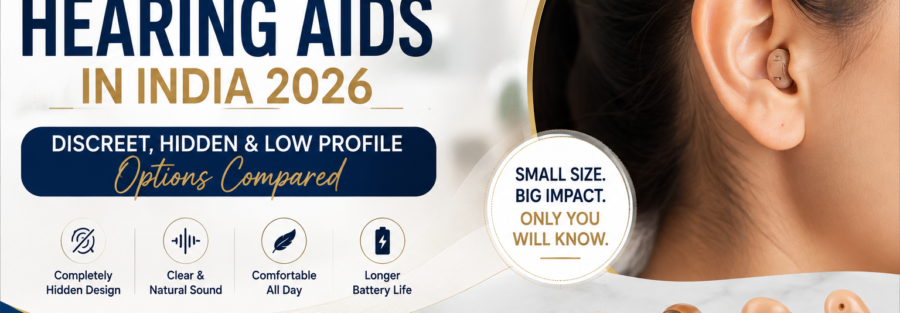
Hearing loss touches millions of Indians, yet a surprising number of people put off getting help for one simple reason. They don’t want anyone to know. That hesitation is real, and it’s costly. Here’s the good news: the best non-visible hearing aids in India 2026 have quietly closed the gap between “device I can hide” and “device that actually works well.” If you’ve been waiting for a solution that disappears into your ear canal while still delivering clear, natural sound, this guide is for you.
At Signature Hearing Solutions, we fit, program, and service these discreet devices every week. We’ve watched patients walk in nervous about the stigma and walk out wearing something no one can spot. This article breaks down the best non visible hearing aids available right now, how they compare, what they cost, and how to choose the right one. Let’s get into it.
Why People Choose Non Visible Hearing Aids
Let’s be honest about the elephant in the room. A lot of people avoid hearing aids because of how they look, not how they perform.
Research on hearing aid adoption backs this up. Studies have found that a large share of older adults who could benefit from amplification skip it partly because of the stigma tied to looking old or disabled. The visible device becomes a badge nobody wants to wear. And that’s a shame, because untreated hearing loss links to social isolation, cognitive decline, and depression.
Non-visible hearing aids solve the cosmetic problem head-on. The best non visible hearing aids sit deep inside the ear canal where nobody can see them. No hook curling over your ear. No wire. No bulky shell filling the bowl of your ear. Just clear sound and a device that stays your secret.
But discretion isn’t the only reason people pick the best non visible hearing aids. There are practical wins too:
- Natural sound funneling. When a device sits deep in the canal, your outer ear does what nature designed it to do — it collects and shapes sound before it reaches the microphone. Many wearers describe the result as more natural than behind-the-ear models.
- Reduced wind noise. Because the microphone sits inside the ear rather than exposed behind it, wind interference drops. Golfers, walkers, and anyone who spends time outdoors notices this.
- No conflict with glasses or masks. If you wear spectacles, a behind-the-ear device competes for the same real estate. Discreet in-canal models leave that space free.
- Comfort for active lifestyles. No external parts means less to snag, fall off, or fuss with during exercise.
Worth noting: the best non visible hearing aids aren’t right for everyone. We’ll cover the limitations honestly later in this guide. But for mild to moderate hearing loss — which describes the majority of Indian patients we see — they’re often an excellent fit.
What Exactly Counts as a Non Visible Hearing Aid?
The term gets used loosely, so let’s clear it up. “Non visible,” “invisible,” “discreet,” “hidden,” and “low profile” all point to the same family of devices: hearing aids that sit inside the ear canal rather than behind the ear.
Within that family, there are distinct styles. Understanding them helps you shop smarter.
In-the-Canal (ITC)
ITC devices fit in the lower portion of the ear canal, a bit like a snug earbud. They’re visible if someone looks closely, but far less prominent than a behind-the-ear model. Because they’re slightly larger, they pack more power and features and can handle mild to moderately severe loss. Think of ITC as the entry point into the discreet category.
Completely-in-the-Canal (CIC)
A step smaller than ITC. CIC devices sit mostly inside the ear canal, with only a tiny faceplate or removal handle visible at the opening. Most of what people call the best non visible hearing aids fall into this category. They suit mild to moderate hearing loss and strike a smart balance between concealment and functionality.
Invisible-in-the-Canal (IIC)
The smallest and most concealed style of all. IIC devices sit deep in the second bend of the ear canal and are genuinely hard to spot — often only a thin removal wire hints they’re there. These are the true hidden hearing aids, the most concealed of the best non visible hearing aids. The trade-off? Smaller size usually means fewer features and no room for directional microphones, so background noise performance can suffer.
Extended-Wear / Deep-Insertion Devices
A specialised category worth mentioning. Some devices are placed deep in the canal by a professional and worn continuously for weeks at a time before replacement. They’re the most invisible option on the market but require prescription fitting and ongoing professional support.
Here’s a quick way to remember it: the deeper and smaller the device, the more invisible it is — and the more you trade away in battery life, power, and smart features. The best non visible hearing aids for you depend on where you want to land on that spectrum.
How We Evaluate the Best Non Visible Hearing Aids
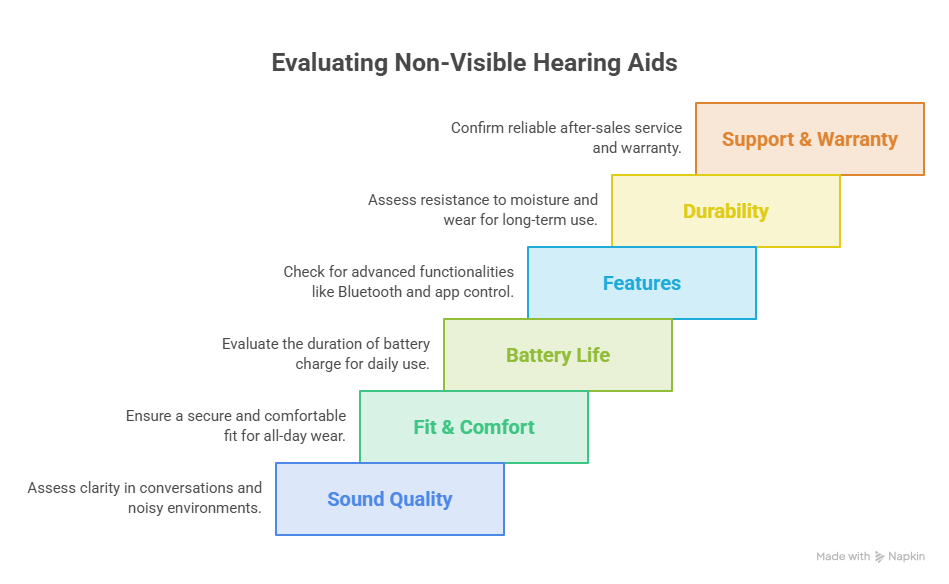
Before we get to specific picks, it helps to know what actually separates a great discreet device from a mediocre one. When our audiologists assess these products, we weigh several factors.
Sound quality and clarity. This is non-negotiable. A device you can’t see is useless if it doesn’t help you hear speech clearly. We test how well each model handles conversation, television, and noisy environments.
Fit and comfort. A discreet device lives deep in your ear canal all day. If it pinches, itches, or works loose, you won’t wear it. Custom-moulded shells and multiple dome options matter enormously here.
Battery life. Smaller devices have smaller batteries. Rechargeable models now dominate, but runtime varies widely — anywhere from 16 to 24 hours per charge among the leading options.
Features. Bluetooth streaming, app control, noise reduction, and directional microphones are harder to squeeze into tiny shells. Some non visible hearing aids skip these entirely; premium models find room for them.
Durability and moisture resistance. Ears are warm, humid places. A good device resists wax, sweat, and moisture without constant failure.
Support and warranty. Especially in India, after-sales service makes or breaks the experience. Programming, cleaning, adjustments, and repairs need a reliable local partner.
With that framework set, let’s look at the leading options for the best non visible hearing aids in India 2026.
The Best Non Visible Hearing Aids in India 2026
The Indian market now offers the best non visible hearing aids from every major global manufacturer, plus locally serviced options that make ownership far easier. Below are the categories of the best non visible hearing aids our clinic works with and recommends most often. Availability, exact pricing, and model names shift over time, so treat this as a directional guide and confirm current specifics with a hearing professional.
Best for Deep Invisibility: Extended-Wear Devices
If total concealment is your top priority, deep-insertion extended-wear devices lead the pack. Placed by an audiologist and worn continuously, they vanish completely into the ear canal. Wearers keep them in during sleep and showers (though not fully submerged). For people who never want to think about their device — no charging, no daily insertion — these are the best non visible hearing aids for pure concealment. The catch: they need professional replacement every few weeks and cost more over time.
Best for Everyday Discretion: CIC Rechargeable Models
For most patients, a completely-in-the-canal rechargeable device is the sweet spot among the best non visible hearing aids. These sit almost entirely inside the ear, recharge overnight, and deliver reliable sound for mild to moderate loss. Brands like Signia, Phonak, Widex, Starkey, and Resound all offer CIC options in India with strong clarity and comfort. This is the category where the best non visible hearing aids and everyday practicality meet most comfortably.
Best for Features in a Small Shell: Premium ITC Models
Want some smart features without a behind-the-ear device? Premium in-the-canal models make room for Bluetooth streaming, app control, and better background-noise handling while staying reasonably discreet. They’re slightly more visible than CIC or IIC devices but far less noticeable than traditional aids — among the best non visible hearing aids for people who want features.
Best Value: Entry-Level Discreet Digital Aids
Not everyone needs flagship technology. Entry-level digital in-canal devices deliver solid amplification and discretion at a far friendlier price. For first-time users testing whether a discreet device suits them, these value models are a sensible starting point among the best non visible hearing aids. Our team helps patients find genuinely good budget options rather than pushing the most expensive shelf.
Best for Personalised Fit: Custom-Moulded In-Canal Aids
Off-the-shelf domes work for many people, but ear canals are as individual as fingerprints, which is why the best non visible hearing aids are often custom-moulded. Custom-moulded shells, made from an impression of your ear, deliver a fit that stays secure and comfortable all day. For anyone with an unusual canal shape, an active routine, or a history of devices working loose, custom moulding transforms the experience. This is often where the best non visible hearing aids truly earn their reputation for comfort.
Comparison Table: Non Visible Hearing Aid Styles
Here’s how the main discreet styles stack up against each other. Use this to narrow down which of the best non visible hearing aids fits your needs before you book a consultation.
| Feature | ITC (In-the-Canal) | CIC (Completely-in-Canal) | IIC (Invisible-in-Canal) | Extended-Wear |
| Visibility | Low | Very low | Nearly invisible | Completely invisible |
| Suits hearing loss | Mild to moderately severe | Mild to moderate | Mild to moderate | Mild to moderately severe |
| Battery | Rechargeable / disposable | Usually rechargeable | Usually disposable | Non-removable, pro-replaced |
| Bluetooth possible | Often | Sometimes | Rarely | No |
| Directional mics | Usually | Sometimes | Rarely | No |
| Handling ease | Easiest of the group | Moderate | Hardest (very small) | No handling needed |
| Professional fitting | Recommended | Recommended | Required | Required |
Notice the pattern. As you move right — toward more invisible — you gain concealment but give up features, battery flexibility, and easy handling. The best non visible hearing aids for you sit wherever your priorities balance out.
Comparison Table: Discretion vs Practical Trade-Offs
Different buyers weigh discretion differently. This second table maps common priorities to the best non visible hearing aids that usually serve them.
| Your Top Priority | Best Style Match | Why |
| Total invisibility | IIC or extended-wear | Sits deepest in the canal |
| Never charging or handling a device | Extended-wear | Pro-placed, worn continuously |
| Bluetooth and phone streaming | Premium ITC | Larger shell fits the electronics |
| Best value for money | Entry-level digital in-canal | Solid performance, lower cost |
| All-day comfort | Custom-moulded CIC | Shaped to your exact ear |
| Handling with limited dexterity | ITC | Largest and easiest to manage |
| Active outdoor lifestyle | CIC or IIC | Less wind noise, nothing to snag |
How to Choose the Best Non Visible Hearing Aids for You
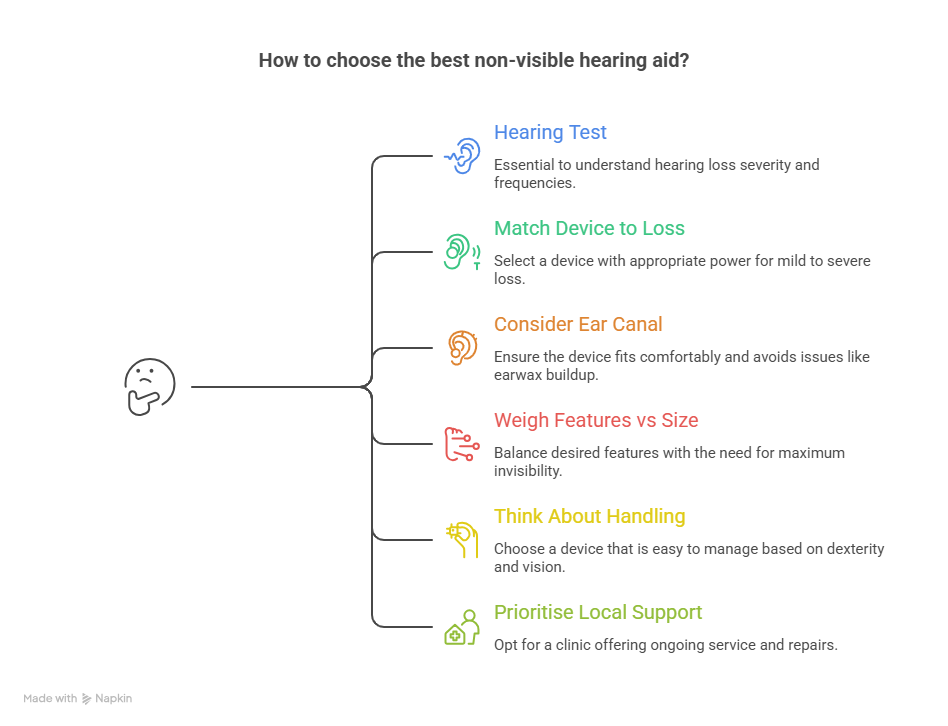
Choosing well isn’t about picking the smallest device or the most expensive one. It’s about matching the best non visible hearing aids to your hearing, your ears, and your life. Here’s how our audiologists guide patients through the decision.
Step 1: Get a Proper Hearing Test
Everything starts here. You can’t choose the right device without knowing the shape and severity of your hearing loss. A professional audiogram maps exactly which frequencies you’re missing and how badly. This single step rules out unsuitable options and prevents wasted money. At Signature Hearing Solutions, our assessments use modern diagnostic equipment to get this precisely right.
Step 2: Match the Device to Your Loss
If your loss is mild to moderate, you have the full menu of the best non visible hearing aids. If it’s more severe, the smallest IIC devices may lack the power you need, and a slightly larger ITC or even a well-fitted behind-the-ear model might serve you better. Honesty here saves disappointment later.
Step 3: Consider Your Ear Canal
Narrow or sharply curved canals don’t suit every device. Frequent earwax buildup or a history of ear infections can also rule out deep-insertion styles. A quick physical examination tells us what your ears can comfortably accommodate.
Step 4: Weigh Features Against Size
Do you need Bluetooth to stream calls? App control to adjust settings? Directional microphones for restaurants? Each feature needs physical space. If features matter more than maximum invisibility, a premium ITC beats a bare-bones IIC. If pure concealment wins, you accept fewer bells and whistles.
Step 5: Think About Handling
Small devices demand nimble fingers and decent eyesight to insert, remove, and clean. If dexterity or vision is a concern, a slightly larger device — or an extended-wear option that a professional manages — makes daily life far easier.
Step 6: Prioritise Local Support
A brilliant device from an unreachable seller is a bad buy. Programming needs fine-tuning over the first weeks. Wax guards need changing. Occasional repairs happen. Buying from a clinic that offers ongoing service, like ours in Ahmedabad, means help is always close. This is the quiet factor that separates a happy owner from a frustrated one.
What the Best Non Visible Hearing Aids Cost in India
Let’s talk about money, because it’s usually the biggest question. Pricing for the best non visible hearing aids in India spans a wide range, driven by technology level, features, brand, and whether the device is custom-moulded.
At the entry level, basic digital in-canal aids can start in the lower tens of thousands of rupees per device. Mid-range CIC models with better sound processing and rechargeability sit higher. Premium models with Bluetooth, advanced noise reduction, and custom moulding command the top prices, and can run well into the higher tens of thousands or more per device. Extended-wear deep-insertion devices carry ongoing replacement costs that add up over the year.
A few things worth knowing about pricing:
- Per device vs per pair. Most people with bilateral loss need two devices. Quotes are sometimes per ear, so always confirm.
- What’s bundled? A good price often includes fitting, programming, follow-up visits, and a warranty. A cheap price that excludes all of that isn’t really cheap.
- Financing. Many clinics, including ours, offer flexible payment options so cost doesn’t force you into a lesser device.
- Warranty and trial. A trial period lets you test whether a discreet device genuinely works for you before committing fully.
Our philosophy at Signature Hearing Solutions is simple: premium hearing solutions at the lowest sensible price, with guaranteed after-sales support. We’d rather fit you with the right device at a fair price than oversell you on features you’ll never use.
Benefits of the Best Non Visible Hearing Aids
The best non visible hearing aids bring real advantages. We’ve touched on these, but they’re worth gathering in one place because they explain why demand keeps rising.
They protect your privacy. Nobody sees them. For people who feel self-conscious about hearing loss, this alone changes everything. Wearers report feeling more confident in meetings, at social gatherings, and on video calls.
They sound natural. Deep placement lets your outer ear shape sound the way nature intended, which many people find more comfortable than devices sitting outside the ear.
They cut wind noise. The tucked-away microphone shrugs off breeze that would whistle through an exposed behind-the-ear device.
They stay out of the way. No competition with glasses, masks, or long hair. Nothing to knock loose during a workout.
They encourage earlier adoption. This is the underrated benefit. Because discreet devices remove the stigma barrier, people get help sooner — and earlier treatment leads to better long-term outcomes for both hearing and cognition.
Limitations You Should Know About
No device is perfect, and we’d be doing you a disservice to pretend the best non visible hearing aids are the exception. The best non visible hearing aids come with genuine trade-offs.
Shorter battery life. Tiny shells hold tiny batteries. Even the best rechargeable models top out around 24 hours, and many deliver less. Heavy streaming drains them faster.
Fewer advanced features. Directional microphones, powerful Bluetooth, and the most sophisticated noise processing often need more space than an IIC or CIC shell provides.
Power ceilings. These devices excel at mild to moderate loss. For severe or profound loss, they may simply lack the amplification you need.
Fit sensitivity. Narrow canals, frequent wax, or recurring infections can make deep-insertion devices uncomfortable or impractical.
Handling difficulty. Small size challenges anyone with reduced dexterity or vision. Inserting, removing, and cleaning takes practice.
More frequent cleaning. Sitting deep in the canal, these devices meet more wax and moisture, so they need daily care and periodic professional cleaning to keep performing.
None of these are dealbreakers for most patients. But they’re reasons to get professional guidance rather than buying blind online.
Caring for Your Non Visible Hearing Aids
Buy the best non visible hearing aids, neglect them, and you’ll be disappointed within months. The best non visible hearing aids demand a little discipline. The payoff is years of reliable service.
Clean them daily. Wipe the device with a soft, dry cloth and use the supplied brush or pick to clear wax from the receiver and vents. Wax is the number-one killer of in-canal devices.
Store them dry. Keep the device in its case overnight, away from moisture, hairspray, and heat. A drying kit or dehumidifier helps in humid Indian conditions, especially during monsoon.
Change wax guards on schedule. These little filters protect the electronics. Replace them as recommended — it’s cheap insurance.
Handle over a soft surface. Drop a tiny device on a hard floor and you may never find it, or you may crack it. Insert and remove over a bed or towel.
Book professional cleanings. Every few months, let your clinic deep-clean the device. We spot developing issues before they become failures and keep your aids performing like new.
Keep programming appointments. Your hearing can change, and your device settings should keep pace. Regular check-ins keep the sound dialled in.
Why Choose Signature Hearing Solutions for Your Discreet Hearing Aids
Buying the best non visible hearing aids is easy. Getting the right device, fitted properly, and supported for years is the hard part — and that’s exactly where we come in.
Based in Ahmedabad, Signature Hearing Solutions offers the full journey to the best non visible hearing aids under one roof. It starts with an accurate hearing assessment using advanced diagnostic methods, so we understand your hearing before recommending anything. From there, our consultation is genuinely personalised. We listen to your lifestyle, your concerns about visibility, and your budget, then guide you to suitable options rather than pushing a fixed product.
Our specialists handle professional fitting and precise programming, tuning each device to your unique hearing profile. And we don’t disappear after the sale. Servicing, cleaning, adjustments, wax-guard changes, repairs, and follow-up support are all part of what we do. Patients tell us honesty stands out — we recommend based on what helps you, not what earns us the most.
If you’ve been putting off hearing help because you dread the look of a bulky device, come talk to us. The best non visible hearing aids in India 2026 might be exactly the discreet, comfortable solution you’ve been waiting for. Book a consultation, take a hearing test, and let’s find the device no one will ever notice — except you, hearing clearly again.
Understanding Hearing Loss Before You Shop
Here’s something we tell every patient who walks in asking about the best non visible hearing aids: the device matters less than the diagnosis. You wouldn’t buy prescription glasses without an eye test, and hearing works the same way.
Hearing loss comes in degrees — mild, moderate, moderately severe, severe, and profound. It also comes in shapes. Some people lose high frequencies first, struggling to catch consonants and children’s voices while low tones stay clear. Others lose across the board. A discreet in-canal device that suits one pattern may frustrate another.
Age-related hearing loss, called presbycusis, is the most common type we fit the best non visible hearing aids for in India. It creeps in gradually, often starting in the higher frequencies. Because it’s slow, many people don’t notice until family members complain about the television volume. By then, the loss may have progressed further than expected. This is exactly why early testing matters — and why the best non visible hearing aids work so well for this group. Most presbycusis sits in the mild-to-moderate range that discreet devices handle beautifully.
Noise-induced hearing loss is another common culprit, especially for people who’ve worked in loud environments — factories, construction, music, traffic. This type often carves out a specific frequency notch. A good audiologist reads that notch on your audiogram and programmes your device to compensate precisely.
The point is this: your path to the best non visible hearing aids runs through a proper hearing assessment. Skip that step and you’re guessing. At Signature Hearing Solutions, the test comes first, always. Only once we understand your hearing do we start talking about specific discreet devices.
Non Visible Hearing Aids vs Traditional Hearing Aids: A Real Comparison
Let’s put the two side by side honestly, because the best non visible hearing aids aren’t automatically better than traditional models — they’re better for certain people and situations.
Traditional behind-the-ear (BTE) devices have a shell that rests behind your ear connected to a tube or wire running into the canal. They’re the most visible style, but they’re also the most powerful and feature-rich. For severe hearing loss, they’re often the only realistic choice. They fit larger batteries, stronger amplifiers, and full Bluetooth. Handling is easy because the parts are bigger.
Receiver-in-canal (RIC) devices are a slimmer cousin of BTE, with a tiny wire and speaker in the canal. Less visible than full BTE, still more visible than in-canal styles, but a strong all-rounder.
Now the in-canal family — the best non visible hearing aids. These trade some power and features for concealment and natural sound. For the millions of Indians with mild to moderate loss, that trade is often a clear win. You give up a little; you gain invisibility and comfort.
So who should lean traditional? People with severe or profound loss. People who need maximum battery life. People with dexterity issues who struggle with tiny devices. People who want every premium feature.
And who should lean toward the best non visible hearing aids? People with mild to moderate loss. People who feel self-conscious about visible devices. People who wear glasses or masks. People with active outdoor lifestyles. People who value natural sound funneling.
There’s no universal winner. There’s only the right match for your ears, your loss, and your life. That’s the honest answer, and it’s the one we give at our clinic every day.
Technology Inside the Best Non Visible Hearing Aids
Don’t let the small size of the best non visible hearing aids fool you. Modern discreet devices pack genuinely impressive technology into shells smaller than a coffee bean. Understanding what’s inside helps you appreciate why the best non visible hearing aids cost what they do — and why professional fitting matters.
Digital signal processing (DSP). The brain of the device. DSP chips analyse incoming sound thousands of times per second, amplifying the frequencies you struggle with while leaving others alone. This is why a well-programmed device sounds natural rather than just “louder.”
Noise reduction. Better devices distinguish speech from background noise and quieten the racket while keeping voices clear. In the smallest shells, this feature is more limited, which is one reason IIC devices can struggle in noisy restaurants.
Feedback cancellation. That annoying whistle older hearing aids made? Modern feedback cancellation largely eliminates it by detecting and neutralising the loop before you hear it. The best non visible hearing aids do this quietly and continuously.
Directional focus. Larger in-canal devices can include microphones that focus on sound in front of you — helpful for face-to-face conversation in a crowd. The tiniest devices usually lack space for this.
Rechargeable power. Lithium-ion cells now power most premium discreet devices. Drop them in a charging case overnight and they’re ready by morning. No fiddling with tiny disposable batteries.
Wireless connectivity. Some models stream calls, music, and television audio straight into your ear via Bluetooth. This feature is easier to fit in slightly larger shells, so if it’s a priority, we’ll steer you toward the right size.
The takeaway: the best non visible hearing aids aren’t dumbed-down devices. They’re sophisticated instruments squeezed into an invisible package. Getting the most from that technology requires expert programming — which is precisely the part you can’t buy off a shelf.
Common Myths About the Best Non Visible Hearing Aids
Misinformation about the best non visible hearing aids keeps people from getting help. Let’s bust a few myths about the best non visible hearing aids we hear constantly at our clinic.
Myth: Non visible hearing aids don’t work as well because they’re small. For mild to moderate loss, the best non visible hearing aids perform superbly. Size limits maximum power and some features, but sound quality for appropriate candidates is excellent. Small does not mean weak within their intended range.
Myth: Only expensive devices are worth buying. Not true. Entry-level discreet digital aids help many people significantly. The best non visible hearing aids for you are the ones matched to your loss and budget, not necessarily the priciest on the shelf.
Myth: You can just buy online and skip the professional. You can, but you often shouldn’t. Programming, fitting, and canal suitability need expert input. We’ve re-fitted many patients who bought blind online and struggled. Local support turns a gadget into a genuine hearing solution.
Myth: Hearing aids make you look old, so it’s better to wait. This one’s backwards. Untreated hearing loss ages you far more visibly — you mishear, withdraw, and disconnect. The best non visible hearing aids let you hear well while staying completely discreet. Waiting only makes adjustment harder later.
Myth: All non-visible hearing aids are basically the same. Far from it. Styles, features, power levels, and fit quality vary enormously. That’s the whole reason a professional consultation exists — to sort through the options and find your match.
Who Benefits Most From the Best Non Visible Hearing Aids?
Certain people are especially good candidates for the best non visible hearing aids. If you recognise yourself below, the best non visible hearing aids deserve serious consideration.
Working professionals. If you’re in meetings, presentations, or client calls, a visible device can feel like a liability — fair or not. Discreet aids let you perform at your best without drawing attention.
People new to hearing aids. First-timers often carry the heaviest stigma anxiety. Because the best non visible hearing aids stay hidden, they lower the emotional barrier to getting started. Many patients tell us they’d never have tried a visible device.
Glasses wearers. Spectacle arms and behind-the-ear devices fight for the same space. In-canal devices free that real estate entirely.
Active and outdoor people. Runners, walkers, golfers, gardeners — anyone outdoors benefits from reduced wind noise and nothing to snag. The best non visible hearing aids stay put and stay quiet in the breeze.
Younger adults with hearing loss. Hearing loss isn’t only an older person’s issue. Younger patients, often self-conscious, gravitate strongly toward discreet options that peers won’t spot.
People bothered by the feel of external devices. Some simply dislike having something behind the ear. In-canal placement feels less foreign to them.
If you’re in one of these groups, book a hearing test and ask specifically about the best non visible hearing aids. The right discreet device could change your daily experience more than you expect.
What to Expect at Your Fitting Appointment
Curious what actually happens when you come in for the best non visible hearing aids? Here’s the typical journey at Signature Hearing Solutions, start to finish.
Your journey to the best non visible hearing aids starts here. First, the hearing assessment. We test your hearing across frequencies and build your audiogram. This takes the guesswork out of everything that follows.
Next, the consultation. We discuss your results plainly, explain your degree and pattern of loss, and talk through which discreet styles suit you. We factor in your lifestyle, your visibility priorities, and your budget. No jargon dumps, no pressure.
Then, ear examination and impressions if needed. For custom-moulded devices, we take an impression of your ear canal so the shell fits you exactly. This is a quick, painless process that makes a huge difference to comfort.
After your device arrives, the fitting and programming. We insert the device, check the physical fit, then programme the sound to your audiogram. First impressions of amplified sound can feel strange — your brain hasn’t heard those frequencies clearly in years. We coach you through the adjustment.
Finally, follow-up and fine-tuning. Over the first weeks, we adjust settings as your brain re-learns to hear. We show you cleaning and handling. We schedule check-ins. This aftercare is where the best non visible hearing aids go from “good device” to “life-changing.”
The whole point is that buying the best non visible hearing aids isn’t a transaction — it’s a relationship. Get that relationship right and you’ll wear your device happily for years.
Leading Brands Behind the Best Non Visible Hearing Aids in India
Several global manufacturers compete to make the best non visible hearing aids, and most are available and serviceable in India. Knowing the players helps you shop with confidence.
Signia builds some of the most respected discreet devices, with strong CIC and IIC options praised for natural sound. Their tiny shells still deliver capable processing, which is why they feature often when we discuss the best non visible hearing aids with patients.
Phonak offers a wide discreet range, including extended-wear deep-insertion technology that ranks among the most invisible devices anywhere. For patients whose top priority is total concealment, Phonak frequently enters the conversation about the best non visible hearing aids.
Widex is known for its exceptionally natural, clear sound. Their in-canal models make our shortlist of the best non visible hearing aids for anyone who prizes sound quality above all.
Starkey packs impressive technology into custom in-canal shells and has pushed hard on making the best non visible hearing aids smarter without making them bigger.
Resound and Oticon round out the field with reliable, well-supported discreet devices that regularly appear when we compare the best non visible hearing aids for a given patient.
Here’s our honest take: no single brand makes the best non visible hearing aids for everyone. The best non visible hearing aids for you depend on your audiogram, your ear canal, and your priorities — not on which logo is trendiest. Our job at Signature Hearing Solutions is to match you to the right device across brands, not to sell one label. That brand-neutral approach is exactly how you end up with the best non visible hearing aids for your specific situation rather than the ones with the biggest marketing budget.
Buying Tips: Getting the Best Non Visible Hearing Aids Without Regret
A few closing pointers, drawn from years of fitting the best non visible hearing aids, to help you shop smart and avoid common mistakes.
Tip 1: Test before you commit. A trial period is your friend. The best non visible hearing aids should be tried in your real life — at home, at work, in restaurants — before you finalise. If a seller won’t offer a trial, be cautious.
Tip 2: Confirm what’s included. The best non visible hearing aids should come bundled with fitting, programming, follow-up, and a warranty. A bare device at a low price often costs more once you add these back in.
Tip 3: Prioritise fit over size. People chase the smallest option, but the best non visible hearing aids are the ones that fit your canal comfortably and stay put — not necessarily the tiniest ones on the shelf.
Tip 4: Don’t skip the hearing test. We’ll say it once more because it’s that important. The best non visible hearing aids only work when programmed to your actual audiogram. Buying blind is the single most common regret we fix.
Tip 5: Value local support. The best non visible hearing aids need occasional cleaning, wax-guard changes, reprogramming, and repairs. A nearby clinic makes ownership painless. This is where buying locally beats buying online every time.
Tip 6: Be realistic about features. If you want Bluetooth and directional microphones, accept a slightly larger shell. The best non visible hearing aids at the very smallest sizes trade features for concealment — know that going in.
Tip 7: Think long term. The best non visible hearing aids are an investment in years of better hearing, richer relationships, and sharper cognition. Judge value over the device’s lifetime, not just the sticker price.
Follow these seven tips and you’ll walk away with the best non visible hearing aids for your ears — and none of the buyer’s remorse we so often help people undo. When you’re ready, our team in Ahmedabad is here to guide every step.
Also read: Digital Hearing Aids: Best Picks, Price & Benefits · Hearing Aid Price in India 2026 · Hearing Care Services in Ahmedabad. Background on hearing health is also available from the NIH / NIDCD.
Final Thoughts
The stigma that once kept people from getting hearing help is fading fast, and discreet technology is a big reason why. The best non visible hearing aids in India 2026 prove you no longer have to choose between hearing well and hiding your device. Whether you lean toward a completely invisible IIC, a practical CIC, a feature-rich ITC, or an extended-wear device you never think about, the best non visible hearing aids offer a hidden solution built for your ears and your life.
The smartest move isn’t shopping by price or size alone. It’s getting a proper hearing test, understanding your options, and working with a clinic that supports you long after the sale. If clearer hearing without the visible hardware sounds right, Signature Hearing Solutions is ready to help you find your perfect discreet match. Better hearing leads to a better, more confident everyday life — and now it can stay completely your secret.
Frequently Asked Questions
What are the best non visible hearing aids for mild hearing loss?
For mild hearing loss, completely-in-the-canal (CIC) and invisible-in-the-canal (IIC) devices are usually the best non visible hearing aids. They sit deep in the ear canal, stay hidden, and deliver clear sound for milder losses. A hearing test confirms which style suits your specific audiogram, so book an assessment before deciding.
Are non visible hearing aids as effective as behind-the-ear models?
For mild to moderate hearing loss, discreet in-canal devices perform excellently and many wearers prefer their natural sound. For severe or profound loss, behind-the-ear models may offer more power and features. The right choice depends on your degree of loss, which a professional evaluation determines.
How much do the best non visible hearing aids cost in India?
Prices range widely, from the lower tens of thousands of rupees for entry-level digital devices to significantly more for premium, custom-moulded models with advanced features. Cost depends on technology, brand, features, and whether fitting and support are bundled. Confirm exactly what a quote includes before comparing prices.
Can discreet hearing aids have Bluetooth?
Some can, but many of the smallest hidden hearing aids skip Bluetooth because of limited space. Premium in-the-canal models are more likely to include streaming. If Bluetooth matters to you, a slightly larger ITC device usually offers it while staying far less visible than a traditional aid.
How long do non visible hearing aids last?
With proper daily cleaning and regular professional maintenance, most discreet in-canal devices last around three to five years. Battery life per charge ranges from roughly 16 to 24 hours for rechargeable models. Good care habits and periodic servicing at your clinic extend the working life significantly.
Who should not use non visible hearing aids?
People with very narrow or curved ear canals, frequent earwax buildup, recurring ear infections, or severe-to-profound hearing loss may not be ideal candidates. Reduced dexterity or vision can also make handling difficult. A professional examination determines whether a discreet in-canal device is a safe, comfortable fit for you.
Are low profile hearing aids comfortable to wear all day?
Yes, especially when custom-moulded to your ear. A well-fitted low profile device becomes barely noticeable within days of wear. Comfort depends heavily on correct sizing and fitting, which is why professional fitting matters more than buying an off-the-shelf device online.
Where can I buy the best non visible hearing aids near me in Ahmedabad?
Signature Hearing Solutions in Ahmedabad offers hearing tests, discreet hearing aid consultation, fitting, programming, and full after-sales support. We help you compare the best non visible hearing aids, choose the right style for your hearing and budget, and support the device for years. Book a consultation to get started.